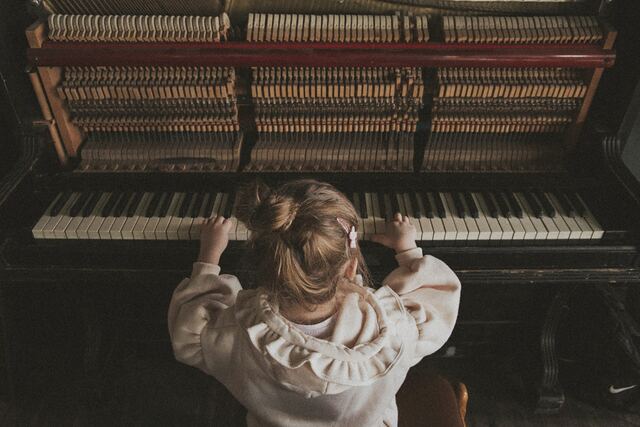
Almost everyone arrives at this question wanting a list: which three pieces should we do for Grade 1? I would rather give you the thing the list cannot — a way of choosing three that suit the player in front of me, because the same three pieces are an excellent programme for one child and a miserable term for another.
Two facts shape everything else, so let us get them out of the way first.
The pieces are most of the exam
Three pieces, and they carry about two-thirds of the marks whichever board you enter. Everything else — scales, sight-reading, aural, technical work — shares the rest.
That is worth sitting with, because the usual order of preparation is the reverse. Scales get drilled weekly from the start, the pieces get chosen from whatever is at the front of the book, and sight-reading gets remembered in the last fortnight. If you flipped the effort to match that picture, most Grade 1 candidates would go up a mark band.
It also means the choice of pieces is not the pleasant bit before the real work. It is the work, and choosing badly costs more than any other decision in the process.
The second fact: pick for the player, not down the list
The commonest way to choose a Grade 1 programme is to take the first piece from each list that looks manageable. It is efficient, it is what a busy teacher does in the last five minutes of a lesson, and I think it is the single biggest avoidable mistake at this grade.
A seven-year-old is going to live with these three pieces for two or three terms. They will play them on days they are enthusiastic and on days they would rather be anywhere else, and the exam they eventually sit will be a fair reflection of how they felt about them.
This is not just my prejudice, as it happens. A group of researchers in Australia followed a cohort
of young instrumentalists for a decade and then went back to ask the ones who had stopped why they
stopped. The reasons that came back were not about talent or time as often as you would expect.
They were about feeling no good at it, feeling alone in it, and — over and over — feeling that
none of it was theirs. One of them, asked why they had stopped, answered:
forced to practice music that was not of my choosing
. By the fifth year of that study, half
the children had given up.1
Nobody quits at Grade 1 because of a piece. They quit two years later, and the piece was one of the bricks in it.
So the first question I ask is not what standard they are at. It is which of these do you actually like — and I play them, rather than describing them, because a seven-year-old cannot read a title and know. It costs ten minutes and it repays them tenfold.
What a good programme looks like
ABRSM sorts its repertoire into three lists and asks for one piece from each. The lists are not difficulty tiers; they are characters. List A is the quicker, more athletic music. List B is the lyrical, singing music. List C is everything else — folk, jazz, film, contemporary writing, music from outside the European tradition. Trinity does not label its list that way, but asks for a "balanced programme", which is the same instruction phrased as a request.
So the structure is already telling you what a programme is for: it should show three different things about the player. In practice I choose them like this.
- One they love. Non-negotiable, and it usually comes from List C. This is the piece that gets practised in December when nobody is practising anything.
- One that flatters them. Something that sits inside what their hands already do well — a singing right-hand tune for a child with a good ear, something rhythmic and rocking for a child who cannot sit still. This is the piece that will be secure in the room.
- One that costs them something. A real technical demand, chosen deliberately, because a grade is meant to move a player forward and two comfortable pieces plus one hard one is a term of genuine progress. One. Not three.
Two comfortable and one stretching is a programme. Three stretching is a bad autumn and, quite often, a merit that should have been a distinction.
Five rules in the small print that people miss
All of these are in the boards' own specifications, and every one of them widens the choice.
You may play a duet. At ABRSM Grades Initial to 3, one of the three pieces may be a duet, with the candidate on the part the list specifies. You bring your own partner, who may be the teacher. For a nervous child, playing one of the three with a person beside them changes the experience of the whole exam — and it is astonishing how few people use it.
Hand size is allowed for. If a stretch is genuinely beyond a small hand, ABRSM permits chords to be spread or a note left out, provided the result is musical. That quietly opens up pieces a small seven-year-old would otherwise be shut out of. Choose for the hand first, then apply the rule — do not choose an unreachable piece and plan to thin it out.
Pedalling is judged on effect, not on obedience. Printed pedal marks may be adapted or left out; what is assessed is the sound. But the corollary is the useful bit: a piece that depends on the pedal for its effect is the wrong choice if the pedal is not yet manageable, which for many Grade 1 pianists means the feet do not reach.
Repeats are usually not played. Unless the piece says otherwise, da capo and dal segno are observed but ordinary repeats are not — so a piece may be half as long as the page suggests. Worth checking before ruling something out as too much to learn.
Memory earns nothing. You may play from memory and no marks are given for it. A child who wants to is welcome to; a child who is steadier with the music in front of them should have it there, and the music must be available for the examiner either way.
The bit that decides it in late 2026
ABRSM rewrites its piano lists every two years. The current one is replaced on 1 January 2027 by the 2027 & 2028 list — but it does not vanish that day. ABRSM allows a one-year overlap: pieces from the 2025 & 2026 list can still be played in exams until 31 December 2027, on one condition — all three pieces must come from the same list. Trinity took a different decision after 2021 and no longer retires its piano repertoire at all — its pieces are published as valid indefinitely, with new books added rather than old ones withdrawn.
What that means in practice, right now: a student who starts three pieces from the current ABRSM list this autumn and is not ready to sit until the spring has lost nothing — the pieces are still good, provided you do not swap one of them for a piece from the new list. The decision to make deliberately is which list to start on. If the exam is likely to fall in 2027, either list will do and the player's preference should decide it. If it could slip into 2028, start on the new list now, because the old one closes on 31 December 2027 and a piece a child has fallen in love with is a miserable thing to take away. Andrew Eales has reviewed the new books piece by piece, which is the quickest way to see whether the incoming list has the piece your player will love before you commit to either.
The overlap terms are ABRSM's to set and they publish them each time a syllabus turns over; the ones above were read on the board's own site in August 2026, and they are worth checking rather than assuming if you are entering after that.
The rest of the exam, briefly, because it changes the choice
The two boards are equally respected, they are both regulated qualifications at the same level, and neither is easier. But they ask for different things around the pieces, and for a particular student that difference is sometimes decisive.
| ABRSM Grade 1 | Trinity Grade 1 | |
|---|---|---|
| Pieces | Three — one from each of Lists A, B and C | Three from one repertoire list, balanced |
| Own composition | Not in Practical Grades | Yes — may replace one listed piece |
| Technical work | Scales and arpeggios, from memory: C major hands together, G and F major and A and D minor hands separately, a contrary-motion C major, and two arpeggios | Scales and broken chords hands separately, two contrary-motion scales, plus three short exercises prepared — of which two are played |
| The other tests | Sight-reading and aural, both compulsory | Any two of sight-reading, aural, improvisation and musical knowledge |
| Marked out of | 150 — pass 100, merit 120, distinction 130 | 100 — pass 60, merit 75, distinction 87 |
| Repertoire expires | Replaced 1 January 2027 by the next two-year list; the current list stays usable until 31 December 2027 (all three pieces from one list) | No — published as valid indefinitely |
The row that changes lives is the fourth one. ABRSM makes aural and sight-reading compulsory; Trinity lets a candidate choose two tests out of four, and one of the four — musical knowledge — is questions about the pieces they have just played and about the notation in front of them. For a child who freezes when asked to sing back a phrase, or who reads slowly, that single choice can be worth a whole mark band, and it is not cheating: knowing your own score is a real musical skill and is being assessed as one.
Improvisation is the other option, and it is the one I most enjoy preparing. It is also the only place in either syllabus at this level where a child is asked to make something up, which some of them turn out to be extremely good at. I teach improvisation, and I teach composition — so for my students choosing that test is a matter of picking the one they enjoy, not the one they can get away with.
And if a student wants to write their own piece, Trinity will take it as one of the three. It is marked as a performance like any other — no marks for the composition itself, and none deducted for it being simple — which is exactly the right way round for a nine-year-old with an idea. If that appeals, say so early: a piece of your own is the one item on the programme that cannot be chosen badly, because it is chosen by the person playing it.
There is a third option, and it suits some children better than either
ABRSM also offers Performance Grades at every level. Four pieces, played straight through as one continuous performance, recorded on video and submitted — no scales, no sight-reading, no aural, no examiner in the room. Three come from the same lists as the practical exam; the fourth is the candidate's own choice, and may be their own composition. At Grade 1 the whole programme has a six-minute ceiling.
It is the same qualification level, marked out of the same 150, with the remaining thirty marks going to the performance as a whole rather than to any test. For a child who plays beautifully and falls apart in front of a stranger, or for a family two hours from the nearest exam centre, it is a genuinely better exam and not a soft option — you get to record it more than once, but you also have to hold four pieces together in one take.
How long Grade 1 actually takes
Both boards publish an estimate, and they agree to the hour: twelve hours of lessons and sixty hours in total for Grade 1, counting the practice. That is a helpfully unromantic number. At a half-hour lesson a week it is most of an academic year, and around fifteen minutes of practice on most days.
My own rule of thumb for the three pieces: learn them in sequence, not in parallel. Get the one they love properly under the hands first, because it builds the appetite for the other two. Have all three playable by about six weeks before the entry deadline, and spend those six weeks making them musical rather than learning notes — which is where the marks between a pass and a distinction live.
The exam itself is about twelve minutes. It is much shorter and much friendlier than everybody imagines.
And whether to enter at all
Grade 1 is genuinely useful for the right student. It gives shape to a year, it produces a certificate at an age when certificates matter enormously, and it makes a child play three pieces properly to the end rather than half-learning twelve.
It is also entirely optional, and for a student who is playing well and enjoying it, an exam can turn a pleasure into a deadline. I have taught plenty of people who never sat one and play beautifully. If the honest reason for entering is that it is what one does next, that is not a reason — and if the pieces have been chosen for the player rather than for the list, you will generally find that the student decides for themselves.
References
- Evans, P., McPherson, G. E. & Davidson, J. W. (2013), "The role of psychological needs in ceasing music and music learning activities", Psychology of Music 41(5), 600–619. A ten-year follow-up of school instrumentalists; 104 responded. The proportion no longer playing rose from 15% in the first year of the study to 52% by the fifth.
- Exam requirements, mark allocations, learning hours and syllabus dates are taken from the awarding bodies' current published specifications — ABRSM's Piano Practical Grades syllabus for 2025 & 2026 and its 2027 & 2028 successor, and Trinity College London's piano syllabus — read on 18 August 2026. The overlap rule is from the same ABRSM page ("Specification validity and overlap period": the 2025 & 2026 specification remains valid until 31 December 2027, all three set pieces from the same specification), read the same day. Check the boards' own pages before entering: fees, dates and the overlap terms are theirs to change, and do.


