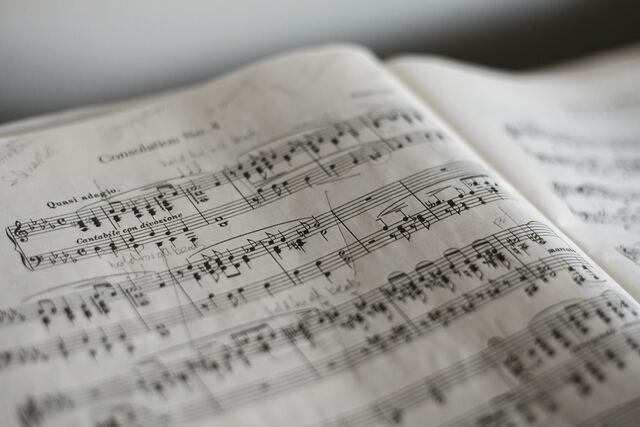
Reading music is not hard. It is taught badly, which is a different problem, and it produces the same result: adults who have decided they cannot do it. What follows is the order I teach it in, which is not the order most books use, and the reason for each step.
One promise before we start. You do not need to be able to read music to play music — some of the best musicians I know cannot, and I would not swap what they have for what I have; there is a whole page here on why I do not start with it. But reading is a shortcut. It is the difference between waiting for someone to show you a piece and being able to go and get it yourself, and once it is in you it never leaves.
Start with rhythm, not with notes
Almost every method book opens with the notes on the stave. It is the wrong end.
Rhythm is the half of notation that is pure arithmetic. It is completely learnable in an afternoon, it does not depend on your instrument, and — this is the part that matters — you can practise it without touching one. Pitch tells you which note; rhythm tells you when. Get a note wrong and it sounds like a wrong note. Get the rhythm wrong and it stops being the tune.
That picture is the whole system. Every row is the row above, cut in half. English has its own names for the rows — semibreve, minim, crotchet, quaver — and America has the sensible ones, which simply say what the fraction is. You will meet both, so it is worth knowing that a crotchet and a quarter note are the same thing and nobody is being clever.
The mechanics are worth one sentence. Start with a hollow head and no stem; add a stem and it halves; fill the head in and it halves again; put a flag on the stem and it halves once more. A dot after a note adds half of the note back on to itself, so a dotted minim is three beats rather than two — the only piece of arithmetic in notation that people reliably get wrong, and it is worth two minutes now.
The time signature at the start tells you how the beats are grouped: the top number is how many beats in a bar, the bottom number is what kind of note gets one. Four-four is four crotchet beats. Three-four is a waltz. Six-eight is two big beats with three inside each, which is why it lilts.
What to actually do: take any piece of music at all and clap the rhythm of the top line while counting out loud. Out loud, not in your head — counting silently is how you convince yourself you are in time when you are not. Do that for ten minutes and you have learnt half of music notation.
Then pitch: the stave is a ladder
Here is the thing that the mnemonics obscure. You were probably taught the lines of the treble stave as Every Good Boy Deserves Favour and the spaces as FACE. Two lists, learnt separately, to be recalled separately — so a beginner who meets a note in a space has to stop and change systems.
But look at what the stave actually is:
Line, space, line, space — going up, the letters simply run in order, and when they get to G they start again at A. There is one list, not two. The mnemonics are a way of remembering an alphabet you already know, and they are the reason so many people can name a note on a line instantly and count up from it painfully to name a note on a space.
What you want instead is two or three landmarks you know without thinking, and the ability to step up or down from them. On the treble stave the obvious landmark is the G that the treble clef curls around — that is what the clef is for, and why it is properly called a G clef. The bass clef is an F clef: its two dots sit either side of the F line. Learn those two, plus middle C, and every other note is at most three steps from something you are certain of.
Why there are two staves, and why that is good news
Piano notation is usually introduced as "one stave per hand", which is not quite what it is, and the difference matters.
It is one ladder with its middle rung taken out. The bass stave carries on where the treble stave left off; the note in the gap is middle C, and it gets a little line of its own — a ledger line — because it belongs to neither stave and sits between them.
The good news in that picture: the bass stave is not a second alphabet to learn. It is the same ladder, and the clef at the front tells you where you have joined it. Once a student sees the two staves as one continuous run, the fear of the left hand tends to go with it.
Sharps, flats, and the sign at the start of the line
A sharp raises a note by a semitone, a flat lowers it by one, and a natural cancels either. On a keyboard a semitone is the very next key, black or white — which is why I teach reading at a piano wherever I can, whatever instrument the student actually plays. On a guitar it is one fret.
Notice what the stave does with them: F and F sharp sit on the same line. The stave is a ladder of letters, not of pitches, and the sharp is an instruction about the letter. This is a feature, not a compromise — it is what lets you see that a tune has gone up a step rather than up a step-and-a-half, at a glance.
The sharps or flats printed at the start of every line are the key signature, and they mean "every one of these, all the way through, unless I say otherwise". They are a labour-saving device. Nobody is asking you to name the key on sight yet, and you do not need to in order to play the piece correctly.
The step everybody skips: read in groups
Here is the thing that separates people who read fluently from people who decode.
Fluent readers do not read note by note. They read patterns — a scale fragment, a broken chord, a shape they have seen a hundred times — and their eyes are already somewhere else by the time their hands play it. This is measurable, and it has been measured since the 1970s: the psychologist John Sloboda measured how far ahead of their hands pianists were actually looking, and found the good ones running roughly twice as far ahead as the weak ones — a matter of six or seven notes against three or four. More interesting still, the good readers' eyes did not run a fixed distance ahead. The gap stretched and shrank so that what they took in was a musical phrase, not a fixed number of notes.1
Which tells you what to practise. Not "recognise notes faster". Recognise groups faster:
- When three notes climb in a row, that is a shape. Read it as one thing, not three.
- When notes skip a rung — line to line, or space to space — that is a third, and a stack of them is a chord. Chords are shapes on the page as much as under the hand.
- When a pattern repeats a step higher, read it once and notice that it moved.
This is also the honest reason theory is worth learning. A student who knows what a scale and a triad are does not read more accurately than one who does not — they read in bigger pieces, because they can see which groups of notes belong together. That is all theory is doing here, and it is worth a great deal.
How to practise reading, and what not to do
Read something easy every day, and never the same thing twice. This is the whole method, and it is the one most people get backwards. Reading practice means playing music comfortably below your level, at sight, once, and then moving on. Playing a piece at your limit forty times is learning a piece — a fine thing to do, but it trains your memory and your fingers, not your eyes.
Keep going. Stopping to fix a wrong note is the single most damaging habit in sight-reading, because it teaches you to read for accuracy at the cost of continuity, and continuity is what the skill actually is. Play through the mistake. Nobody in the room is scoring you.
Look ahead of your hands, on purpose. It feels wrong at first, in the way that looking at the road ahead rather than the bonnet does when you are learning to drive. It is the same skill and it produces the same effect.
Count out loud. Still. Yes, even now.
Ten minutes a day of that will move a beginner further in a month than an hour a week of anything else, and the thing it builds compounds: everything you learn afterwards gets faster, because you can get the notes in without help.
Where all this came from, briefly
It is worth knowing that the stave was invented, by somebody, to solve a specific problem — because it makes the whole system feel less like an arbitrary code. And the specific problem turns out to be the one this article opened with.
Guido d'Arezzo was a Benedictine monk, born around 991, who spent his working life training cathedral singers — first at Pomposa and then, from 1025, at Arezzo. His difficulty was that a chant could only be passed from a teacher who already knew it to a singer who did not, one melody at a time, and that the same chant was consequently sung differently from one church to the next. He wanted a way of writing music down that would teach a singer a tune nobody had sung to them.2
Lines with fixed pitches were not new; earlier systems had them, sometimes as many as eighteen of them, one per note. What Guido did — and this is the part worth knowing, because it is the second diagram on this page — was use the spaces between the lines as well. Suddenly four or five lines could carry what had needed eighteen, and the page became a ladder rather than a harp. He added letters at the left-hand end to say which pitch a given line was, which is what a clef still is, and he coloured two of them — red for F, yellow for C — so a singer could see at a glance where the semitones fell. You can watch the clef doing that job in an English manuscript from around 1300, where it sits on whichever line suits the tune, in Ian Pittaway's reconstruction of "Bird on a Briar", performance included.
He was explicit about what it was for. Writing the preface to his own book of chants, he said his
notation meant a diligent singer, once taught part of a chant, would
recognize the rest unhesitatingly by himself without a teacher
.2
The five-line stave, the round note heads and the rest of it arrived over the following centuries. But line-space-line-space is Guido's, it is a thousand years old this year, and it was built to do exactly what you are trying to make it do.
What actually gets in the way
In my experience it is almost never ability. It is one of three things.
Being taught pitch and rhythm at once. Two unfamiliar systems arriving together, and the student is asked to fail at both simultaneously. Separate them and they are both easy.
Reading music you do not care about. A beginner given twelve bars of graded nothing will practise it dutifully and learn very little. Given the first line of a tune they have loved since they were nine, they will work out things you had not got round to teaching. That is the whole approach I teach by, and reading is where it pays off fastest.
Believing it is a talent. It is a habit. It is much closer to reading words than people expect, right down to the fact that fluent readers of both take in groups rather than characters — and nobody thinks reading English is a gift.
References
- Sloboda, J. A., "The Eye–Hand Span: An Approach to the Study of Sight Reading", Psychology of Music 2(2), 1974; and Sloboda, "Phrase units as determinants of visual processing in music reading", British Journal of Psychology 68, 1977. Reviewed with later work in Perra, J., Poulin-Charronnat, B., Baccino, T. & Drai-Zerbib, V., "Review on Eye-Hand Span in Sight-Reading of Music", Journal of Eye Movement Research 14(4), 2021.
- Burggraff, N., "Guido d'Arezzo: A Medieval Music Theorist's Impact on Today's Training for Worship Leaders", Artistic Theologian vol. 12, 2025 — from which the account of the lines-and-spaces innovation and the coloured F and C lines is taken. Guido's own words are quoted from his Prologus in antiphonarium (c. 1025–32) in Dolores Pesce's critical text and translation, Guido d'Arezzo's Regule rithmice, Prologus in antiphonarium and Epistola ad michahelem (Institute of Mediaeval Music, 1999), pp. 415–17.


