Home · Free tools · Manuscript, tab & blank fretboard diagrams
Manuscript, tab & blank fretboard diagrams
Blank paper to print: staves with a treble, bass or no clef, piano systems, tab for guitar, bass, ukulele and mandolin, and blank fretboard diagrams for chords and scales. A4, one page each, nothing to sign up for — print as many as you need.
Manuscript paper
Five-line staves, ten to a page, with a clef printed at the start of every stave — or none.
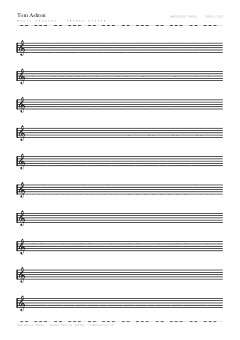
10 staves
Treble clef
Guitar, ukulele, mandolin, the right hand at the piano and most melody instruments read this one.

10 staves
Bass clef
Bass guitar, the left hand at the piano, cello, trombone — anything that lives below middle C.
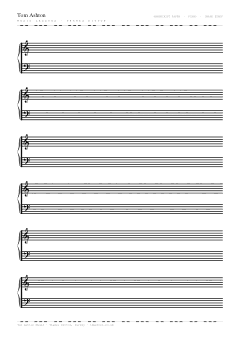
6 systems
Piano · grand staff
Treble over bass, joined by a brace, six systems to the page.
10 staves
Plain · no clef
Ten staves and nothing else. The one for practising drawing clefs, and for any clef the others do not print.
Tab paper
One line per string, the string names down the left. The top line is the highest-sounding string — the one nearest the floor.
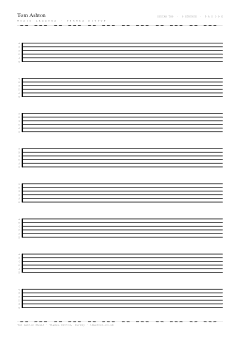
8 staves · 6 lines
Guitar
Six lines, e B G D A E, eight staves to the page. Standard tuning.
10 staves · 4 lines
Ukulele
Four lines, A E C G. Standard tuning, and the same paper whether your G is high or low.
Stave and tab
The layout guitar music is usually printed in: notation above, tab below, one barline through both.

5 systems
Guitar · stave + tab
A treble stave over a six-line tab, five systems to the page — for writing a piece out both ways, or for filling in the one you cannot yet read from the other.
Blank fretboard diagrams
Several blank necks to a page: the nut at the left, the highest string on top, position dots where your instrument has them. For chord shapes, scale patterns and modes — draw a shape, name it above.
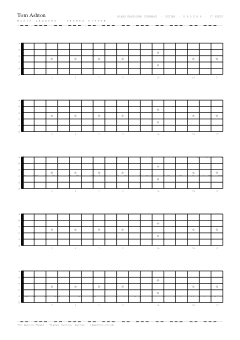
5 necks · 17 frets
Guitar
Six strings, e B G D A E, seventeen frets — as far as the scale shapes reach — five necks to the page: one for each pentatonic box, or each CAGED shape.
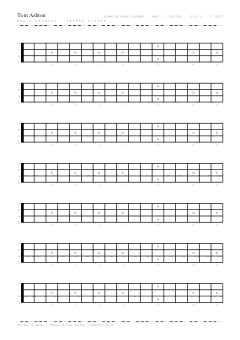
7 necks · 17 frets
Bass guitar
Four strings, G D A E, seventeen frets, seven necks to the page.
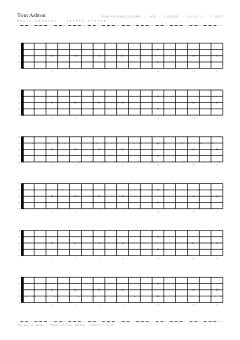
6 necks · 17 frets
Bass guitar · 5 string
Five strings with the low B, seventeen frets, six necks to the page.
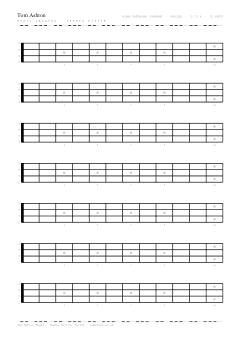
7 necks · 12 frets
Ukulele
Four strings, A E C G, twelve frets — the whole neck of a soprano — seven to the page.

7 necks · 12 frets
Mandolin
Four courses, E A D G, twelve frets to where the neck meets the body, seven to the page.
About the sheets
The staves are 8 mm and there are ten to a page — a little larger and more spaced than a shop-bought pad, because these are for writing on by hand and hands need room. The tab lines are a little over 3 mm apart for the same reason, so a written 12 fits between them.
The tab sheets carry the string names down the left. The top line is the highest-sounding string, the one nearest the floor — the opposite of how the guitar sits in your lap, and worth saying once. The plain sheet has no clef, so it is the one for practising drawing them, and for any clef the others do not print.
The blank fretboard diagrams are the same way up: the nut is the thick bar at the left, the top line is the highest string, and the pale dots sit where the position markers are on the instrument, with the fret number under each so a sheet cannot be read backwards. Draw a chord shape or a scale pattern on a neck and write what it is in the space above. The guitar and bass necks run to the seventeenth fret, which is as far as the scale shapes reach; the ukulele and mandolin necks stop at the twelfth, which is where a soprano ends and a mandolin's neck meets the body.
Print as many as you like, and pass them on. If you need one that is not here — a seven-string guitar, a baritone ukulele, a different tuning down the side, bigger staves for small hands — tell me.