Several melodies happening at once, and every one of them meaning something on its own. That is counterpoint. It is the thing I most want students to be able to hear, because once you can, you cannot stop hearing it — and it turns up in far more of the music you already love than you would expect.
What follows started as a letter to a friend I have spent years trying to infect with this. Two recordings, a few timestamps, and what to listen for. Put headphones on if you can. The whole point is hearing two things at once, and a laptop speaker collapses them into one.
The short definition, and the useful one
The textbook answer: counterpoint is the relationship between two or more musical lines that are independent in rhythm and contour but interdependent in harmony. True, and no use to anybody.
The useful answer is that most music has a tune and some backing. Counterpoint is what happens when there is no backing — when the second line is also a tune, and would be worth hearing entirely on its own, and yet the two of them together make a third thing that neither could manage alone.
Polyphony is the same idea seen from further away: many voices, none of them subordinate. The distinction that matters to a listener is simply this — is the lower part accompanying, or is it arguing?
Listening one — two violins, in perfect democracy
Bach,
Concerto for Two Violins in D minor, BWV 1043 — the slow movement
This is the middle movement of Bach's adored double concerto, and it is where I would send anybody first.
Notice what the orchestra is doing: almost nothing. It is playing rhythm guitar — exquisite harmony that sets up tension and then relaxes it, perfectly, and otherwise stays out of the way. Everything that matters is the interplay between the two fiddles.
And listen to how they behave. Neither wins. One begins a phrase, the other answers it, then takes it somewhere the first had not thought of, and hands it back changed. It is a perfect balance of two voices — pure and perfect musical democracy, which is a thing sound can do because sound is beautifully abstract and does not have to decide who is more important.
There is a lovely accident of casting here too. Menuhin and Oistrakh were two of the greatest soloists of the twentieth century, from opposite sides of a Cold War, and the entire achievement of this recording is that neither of them tries to be the more interesting one. You are hearing two people who could easily have competed choosing not to. That is what the music is about, so it is also the right way to play it.
Then, when you have heard it once for pleasure, go back and count the material. There are only a few little melodic themes in the whole movement. Bach weaves them together with octave transpositions and key shifts, and that is very nearly all he does.
Listening two — Bach enjoying himself
Bach, Toccata and
Fugue in D minor, BWV 565
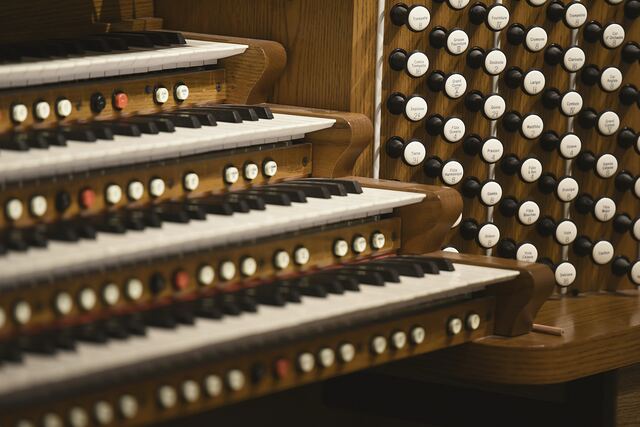
Everybody knows the opening. Fewer people stay for the fugue, which is where the actual argument happens. And for "a real instrument": the physicist Peter Coles has posted a performance in the Berliner Dom in which the organist is audibly playing the building as well as the organ — which is the point of hearing it live.
This is Bach having fun on the instrument he knew best, and it is coupled to an unparalleled mastery of counterpoint and of keyboard technique. It is, frankly, how we all wished we could improvise.
Listen for the same thing as before: very few motives — very few musical bricks — architected into an extraordinary, transiently emotional dialogue. The subject arrives, then arrives again underneath itself, then above, then in a different key while a version of it is still going on somewhere else. Nothing new is being invented. It is the same handful of bricks, put together by somebody who could see the whole building.
Counterpoint.
The principle worth taking away
If you only keep one thing from this, keep this: the bricks are always fewer than you think.
Both of these pieces sound inexhaustible and neither uses much material. What makes them inexhaustible is what is done to the material — inverted, transposed, stretched, put underneath instead of on top, handed to somebody else halfway through a sentence.
That is a genuinely liberating discovery for a student, because it means the thing you are short of is not ideas. Everybody has enough ideas. What takes work is learning what to do with one.
And then go and listen to Pet Sounds
Because Brian Wilson got counterpoint too.
I am not being provocative. Listen to how the vocal lines on that record move against each other — not harmonising in parallel, which is easy and lovely and something else entirely, but genuinely independent lines that happen to fit. Then listen to the bass, which is very often not playing the root of the chord and is arguing with the tune in exactly the way Bach's lower voices argue. Ethan Hein has a page of pop bass lines that refuse the root — Beach Boys and Beatles among them — with the historical point underneath it: the bass lines came first, and the chords were the explanation afterwards.
The wall people put up between "classical" and "pop" is not useful and it is not old. Both of these traditions are saying the same thing: that a good tune and a good bass line are the same idea approached from two ends. The moment a student stops believing in that wall is usually the moment they start improving quickly.
How to start actually playing it
Hearing counterpoint and playing it are different skills, and the second one is more fun than it sounds. Two independent lines under one pair of hands is a real physical puzzle, and the piece of repertoire that teaches it best is not the one people expect — Bach's Two-Part Inventions, fifteen short pieces written for a teenager, which will do more for your playing than a term of exercises.
And if you want an ear for it faster: play one line and sing the other. It feels ridiculous. It works better than anything else I know.

