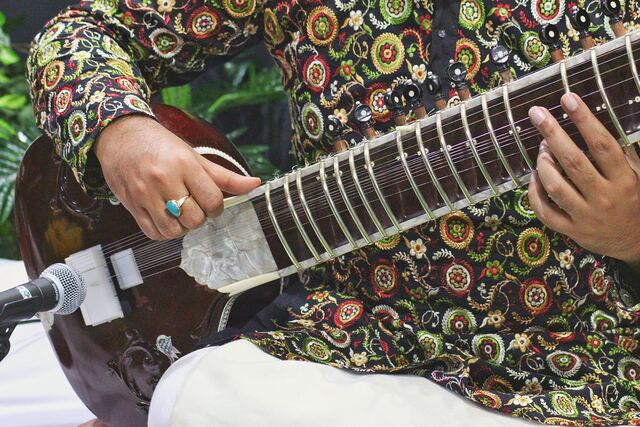
The short answer that gets given most often is "an Indian scale". It is wrong in a way that makes everything afterwards confusing, so it is worth spending five minutes on a better one.
Start with what it is not
A raga is not a scale. A scale is a set of notes; you can write one out in ten seconds and there is nothing left over. Two ragas can use exactly the same notes and be entirely different music — with different rules about which notes you may approach from where, which are stressed and which are passed over, which phrases identify it, and what time of day it belongs to.
It is not a key, because it is not a transposition of anything — it is the material itself.
It is not quite a mode either, though a mode is the closest Western idea and a useful stepping stone. A mode is still fundamentally a set of notes with a tonic. A raga carries much more: it has grammar, it has phrases that belong to it, it has ornaments that are part of its identity rather than added to it, and it has a mood that a performer is expected to be serving.
A better first approximation
A raga is closer to a character than to a scale.
That is the analogy I keep coming back to with students, and it holds up further than analogies usually do. A character in a play has a fixed identity, and yet no two performances are the same. You can recognise them instantly. They can behave in a range of ways, but there are things they would never do, and you would notice at once if they did. What they say has not been written down in advance, but it is not free either.
Ask a musician what raga they are playing and you learn roughly as much as being told which character has just walked on stage. Which notes are in it is only a small part of the answer.
The parts of it, briefly
- The notes — swaras, seven of them, with the same relationship to a fundamental that Western scale degrees have to a tonic. Several exist in flat and sharp forms, which is where the raw material of the different ragas comes from.
- Ascent and descent — aroha and avaroha. Many ragas go up by a different route from the one they come down by, which has no real Western parallel and is one of the first things that surprises a trained musician.
- The important notes — one note the raga rests on and treats as home, another it leans on and uses to answer. These give a raga much of its character, and two ragas with identical notes will usually differ here.
- Characteristic phrases — small groups of notes that belong to that raga and announce it. A listener who knows the tradition often names a raga from a single phrase.
- Ornament — the slides, shakes and bends between notes. In this music these are not decoration. They are where the note lives.
- Time and mood — most ragas are traditionally associated with a part of the day or a season, and with an emotional colour. In practice this is honoured more loosely than it once was, but it is not a museum label: it tells a performer what the piece is for.
And underneath all of it, a drone. Usually a tanpura, holding the fundamental and the fifth, and it never stops. That is the second thing that startles a Western musician: there is no chord progression, nothing modulates, and nothing needs to. Everything happens in relation to a fixed point rather than by moving away from one and coming back.
Why a Western musician should care
I did not go to India to broaden my horizons. I went because I wanted to play the sitar and it is not an instrument you can learn from books. What I brought back turned out to be less about the sitar than about the piano.
Two things in particular.
Ornament stopped being decoration. In Hindustani music a note is not a point you arrive at and hold — it is something that moves, and the movement is the identity. Once I had spent long enough inside that, I sat down with a Bach sarabande and the ornaments looked completely different. They had stopped being instructions printed above the stave and started sounding like the same instinct, five thousand miles and two hundred years away: a note as a thing that moves. My students get the benefit of that whether or not they ever touch a sitar.
Improvisation stopped looking like freedom. A raga performance is largely improvised and almost nothing about it is free. Every choice is constrained by the raga's grammar, and the constraint is what makes the invention meaningful rather than arbitrary. That is a lesson any jazz musician recognises instantly, and one a lot of classical students badly need — playing something of your own is not the opposite of playing within rules.
Where to start listening
Pick one raga and one long recording, and stay with it. That is the opposite of how most people approach it, and it is the only approach that works.
An hour-long performance of a single raga sounds forbidding, but it is doing something quite legible: the opening alap is unmetred and slow, introducing the notes almost one at a time and establishing the character; the pulse arrives later; and it gradually accelerates until the last few minutes are as fast as the instrument will go. Once you know that shape, you are not listening to an hour of unfamiliar music. You are watching something get built.
Yaman and Bhairavi are good places to begin — both are common, both are taught early, and both have enough recordings to compare performances; Rajan Parrikar's essays on each carry dozens of recordings of the same raga by different hands, which is precisely the comparison to make. Listen to two players do the same raga and you will understand the character analogy better than another thousand words here could manage.

